Sunday, June 14, 2015

Military Occupation Of The Caddo Oil Fields 1917-1918

Oil City, Mooringsport, Vivian, and surrounding oilfields were occupied by federal troops in 1917-18, due to a major strike encompassing Louisiana and Texas oilfields by unionized workers seeking better pay and working conditions. In response, military troops were called in to protect oil drilling and production operations as well as nonunion workers. Below is an excerpt from The Role of Federal Military Forces in Domestic Disorders, 1877-1945, c 1997, by Clayton D. Laurie and Ronald H. Cole:

"In Louisiana, Maj. Gen. William P. Duvall of the Southeastern Department ordered companies of the 1st Mississippi Infantry to Mansfield, Oil City, Crichton, Edgerly, and Vinton. They arrived without mishap, and all locations were reported as quiet.

The strike in Oil City, however, showed signs of violence - unconfirmed reports claimed that a laborer had been shot from ambush. The following day the commanding officer informed his superiors that the oil companies would attempt to operate the fields with nonunion labor and requested more troops to prevent anticipated bloodshed. The remaining members of the 1st Mississippi Infantry at Vicksburg were sent to Vivian, Lewis, and Mooringsport, Louisiana, to protect the oil fields and strikebreakers. The soldiers of the 155th Infantry replaced these Mississippi troops and. in turn, the 3d Battalion of the 43d Infantry replaced the 155th in Oil City, Mooringsport. Mansfield, Vinton, and Shreveport, Louisiana, on 18 January 1918.

By late November the Army had deployed 2,500 men in the oil fields of Texas and Louisiana."

A chronology of related activities as reported at the time follows.

Five companies of the 155th Infantry of the Mississippi National Guard depart for undisclosed locations in the Louisiana oilfields, under imminent threat of strike.


Vicksburg (MS) Herald 02-Nov-1917, Page 5

Newly-arrived members of 155th Infantry Company B (from Natchez) joined the striking oil workers in helping to put out a major fire in downtown Oil City.
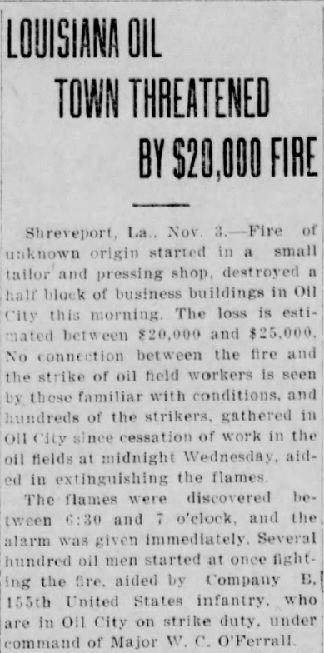


Paris (TX) Morning News 04-Nov-1917, Page 1

An AWOL soldier stationed at OC was arrested in Monroe, apparently on his way back to Mississippi.


Shreveport Times 19-Nov-1917, Page 8


More troops were later moved into the area.


One victim of the occupation was Oil City's notorious Reno Hill vice district.


Though not stated as the reason in the above article, this later one about the closing of Shreveport's "red light" district along Fannin Street mentions the shutting down of Oil City's notorious Reno Hill was by order of the U.S. War Department.


New Orleans Daily States 06-Nov-1917, Page 1


New Orleans Item 17-Nov-1917, Page 4

Pvt. Vincent Lenaz (correct spelling), part of occupying 155th Infantry from Mississippi, was disclosed to have contracted tuberculosis. He died the day this article was published and later was buried in DeLisle Cemetery, Pass Christian, MS.


Rather than treated as an invading force, the soldiers were embraced by the areas in which they were located. Below, ladies of Vivian serve Thanksgiving dinner to Company M, assigned to the Trees area.


North Caddo Parish, by Sam Collier, Page 204

Ladies of the Shreveport Methodist Church wanted to invite soldiers into their homes for Thanksgiving dinner, which was not permitted by the commander. Instead they provided for the troops at the fairgrounds, their base of operations.


Mooringsport residents and school children also showed hospitality to troops quartered there by serving Thanksgiving dinner and a "bountiful fruit shower."


A community singing, attracting 1,500 attendees, was held at the fairgrounds; with music provided by the 155th regimental band.


Shreveport Times 10-Dec-1917, Page 3


Soldiers conducted a special service at Shreveport's First Baptist Church.


Shreveport Times 16-Dec-1917, Sec 3 Page 6


Sergeant Major Smith with Major O'Farrell are mentioned as assigned to Oil City.


Members of Company I of the 155th Infantry, based in Mooringsport, wrote a letter, published in the newspaper, giving thanks to the ladies of Shreveport, who had knitted mufflers and gloves for them. A small token of Christmas cheer for boys away from home.

At least two of these men, Sergeants Clarence Holloway and Joe Freeman (listed as Private here) went to Europe in Jun-1918 on board the USS Rijndam. Others may have as well, but couldn't be confirmed.


Below are the assigned locations of various companies: B in Oil City, I and K scattered around oil fields, with L and M in Trees.


Company B, stationed in Oil City, contributed cash for the Poor children's Christmas. Included are the names of Company members.


A recap of Christmas celebrations held around the area for members of the 155th Infantry, stationed in the oilfields and headquartered at the state fairgrounds. Locations mentioned include Vivian, Caddo (Oil City), Mooringsport, and Trees.


Lieutenant Joseph S. Burns, stationed at Oil City, and wife Bessie were entertained in Shreveport at a dinner given by Mrs. H. Van Dyke. At least some wives of officers accompanied their husbands during the occupation.


In January the 43rd Infantry of the regular army arrives to replace the 155th. Lieutenant J. D. led a unit based in Mooringsport, while Lt. W. Goodlette, said to be popular among his men, was in charge in Oil City.


Commander of the northwest Louisiana operations was Major Sylvester Chouteau Loring, a war veteran who had fought in Cuba and the Philippines.


Retired from the military in 1910 for health reasons, Major Loring returned to service in 1916, possibly to free another able-bodied officer for Europe.


Select U. S. Military Registers 1862-1985, Page 636


The wife of the commanding officer in Mooringsport developed appendicitis and was treated in Shreveport.


Shreveport Times 27-Feb-1918, Page 4


Their mission accomplished, soldiers of the 43rd were withdrawn from the oilfields in March.


Shreveport Times 11-Mar-1918, Page 3


One such soldier involved in the occupation was First Lieutenant Joe De Arozena, of Tuscon, AZ. Note in the newspaper article below, recognizing University of Arizona alumni serving in the military, Lt. De Arozena is listed with the aforementioned 43rd Infantry Regiment stationed in Oil City, LA. 


Tuscon (AZ) Daily Citizen 30-Mar-1918, Page 16


This picture of Lt. De Arozena, whose civilian profession was mining engineer, is from a 1920 passport application.

Joe De Arozena Passport
 Photo (1920)
Passport Application 06-Aug-1920

By April the 43rd was stationed at Camp Nicholls, near New Orleans. In the article below, Mrs J. H. Fullilove, Jr. is reported to have reconnected with officers' wives with whom she made acquaintance earlier during their tenure in Shreveport.


Shreveport Times 06-Apr-1918, Page 7

The 43rd did not go overseas during World War I, instead remaining stateside as a unit, though individual soldiers participating in the oilfield occupation may have later seen duty abroad.


The U. S. Army in World War I: Orders of Battle, Richard Rinaldi (2004), Page 78

Friday, June 5, 2015

Odell Hale - Hosston's Major Leaguer

Arvel Odell Hale (1908-1980) was an infielder for 10 major league seasons, mostly with the Cleveland Indians. Playing second and third base, he had a career batting average of .289; and hit over .300 in four of those years. He additionally had 51 home runs and 573 runs batted in. (1) 


Going initially by his middle name, he was the son of James Monroe and Ella Hale and a graduate of Hosston High School where he played basketball and baseball. (2) He was also known by various nicknames including "Bing," "Sammy," "Chief" (for purported Native American heritage), and "Bad News," (2) (3)

The J. M. (James Monroe) Hale family living in Hosston per the 1920 U. S. Census. 


After high school Odell moved to El Dorado, Arkansas where he worked for Lion Oil and played for the semipro El Dorado Lion Oilers. He began his professional career in Class D Alexandria, LA in 1929, where he caught the attention of major league scouts. Dubbed "Bad News," referring to his impact on opposing pitchers, (once hitting a record-tying seven home runs in six consecutive days), the 1931 New Orleans Times Picayune article below disclosed his preference to be called "Sammy."


Source: Tampa (FL) Tribune 07-Sep-1929, Page 19


Later that year he worked up to the majors playing briefly with the Cleveland Indians. Note he is referred to as "Bing" in the article, which he also was known by in his post-professional days.


 In 1932, he was assigned to Cleveland's minor league team at the time, the Toledo Mud Hens, before returning to the Indians in 1933.

This 1933 article about his return to Cleveland for what would be an eight year run describes his background, including his high school days, and notes he played for a local baseball team afterward. This may have been a semi-pro club as at the time other area communities (e.g., Oil City, Trees City, McLeod, Texas) had teams often affiliated with a locally-based company or operation. He would later manage and play for a similar organization in El Dorado, Arkansas after his major league career.


Source: Cleveland Plain Dealer 04-Jul-1933, Page 12

Hale played against some of the true legends of baseball. In this example, Cleveland defeated New York 3-1 in Yankee Stadium, with Odell getting a RBI. Notable in the Yankee line-up were four of six from the famous "Murder's Row" of 1927 - Babe Ruth, Lou Gehrig, Tony Lazzeri and Earle Combs.


Scranton (PA) Republican 21-Jul-1933 Page 14


Source: New Orleans Times Picayune 19-Mar-1934, Page 10

Odell was once featured on the Wheaties box in 1936, albeit it on the back.


There was even an Odell Hale signature baseball glove.


He was involved in one of the most unusual triple plays ever  in a game on 07-Sep-1935 against the Boston Red Sox in Fenway Park. that began with his being hit by a line drive that glanced off his glove and bounced off his forehead before being caught on the fly by Indian shortstop Bill Knickerbocker to begin the play that retired the Red Sox who had the bases loaded, preserving a Cleveland win.

Hale (left) and teammates Knickerbocker, Roy Hughes, and  Hal Trosky after the triple play


A radio broadcast of the 21-Sep-1939 contest between the Cleveland Indians and the Washington Senators, won 6-3 by the visiting Indians. The broadcast begins in last half of fourth inning. Odell Hale (referred to as Sammy, played 2nd base and has significant plays as follows:

17:50 (grounds out)

44:50 (base hit, RBI)

50:25 (scores run)

1:00:48 (catches fly ball)

1:06:24 (throws force out at second to end 8th inning)

1:08:33 (base hit)

1:14:18 (throws out runner)

For the game, Odell batted 2 for 4 with 2 RBI , one walk, and scored one run.

Sorry, youtube audio for game has been removed. I'll leave the details though in case someone ever uploads again

A newspaper article recapping the game.


Cincinnati Enquirer 22-Sep-1939, Page 15


By 1940, his tenure in Cleveland was over as in the winter of that year, he was dealt to the Boston Red Sox.


New Orleans Times Picayune 13-Dec-1940, Page 27  


There is a very brief view of Odell (far right) at the 0:09 mark of this film of the Boston Red Sox spring training in 1941.

Link


Fenway Park wasn't home for long, as six months later he was off to the New York Giants.


Source: Omaha (NE) World-Herald 20-Jun-1941, Page 25(Page 1 Sports)

By September, his major league days were over as he was sent to the American Association Milwaukee Brewers (not affiliated with the later major league club).


Source: Boston Herald 10-Sep-1941, Page 25

He played for Milwaukee in 1942 and though reported sold to Portland of the Pacific Coast League, for whom he declined to report, he appeared back on the Brewers 1943 roster as a catcher, a position he apparently hadn't played since high school (see above).


Source: Kansas City (MO) Star 25-Apr-1943, Page 2-B (Milwaukee catcher)

By 1945, with his professional baseball career ended, Odell returned to El Dorado and the employ of Lion Oil, from which he eventually retired, working as a plant operator, (5)


He also returned to the Lion Oilers, for whom he'd played years before, and eventually became manager, In that role he led the team to the Arkansas semi-pro title in 1950.

In the last decades of his life, Odell  received little media attention; save for an occasional reference to his past career, or for being the subject of trivia questions.


Source: Cleveland Plain Dealer 14-Feb-1965, Page 5-C 


Cleveland Plain Dealer 11-Nov-1965, Page 58 

Regarding his place in baseball history, a Cleveland Indian fan website ranks him No. 82 among their players all-time. Baseball historian Arthur Schott named Odell to his all-time Louisiana-born team.
He died in 1980 and is buried in Arlington Memorial Park, located in El Dorado..


Sources:

(1) Odell Hale (Wikipedia article)

(2) Biographical Dictionary of American Sports: G-P, David L. Porter (2000), Page 617

(3) The Cleveland Indians Encyclopedia, Russell Schneider (2004), Page 178

(4) Baseball-Reference - Odell Hale

(5) Odell Hale by Bill Nowlin for the Society for American Baseball Research (SABR) 


Sunday, May 17, 2015

No More Free Ferry at Mooringsport!

A letter by Charles Anderson, identified as being from Black Bayou, La. appears in The (Shreveport) Progress (newspaper) 13-Mar-1897 regarding Caddo Parish's continued spending of $600/year to provide the free ferry across Caddo Lake at Mooringsport. He opposes it, which he views as subsidizing that town and points out that the (Kansas City Southern) railroad (at the time only a couple of years old) runs close to most Ward 2 homes and it only costs a dime to ride from Ananias (now Oil City) to Mooringsport. He thinks citizens who wish to cross the lake otherwise should pay their own way. Also interesting is his observation of the decline of Mooringsport as a shipping point, as he cites more cotton is being shipped then from Vivian and Rodessa.


Ten cents in 1897 would be the equivalent of around $2.50 today. Despite Mr. Anderson's protest, the free ferry continued until it was replaced in 1914 by the Caddo Lake drawbridge; itself now replaced (though designated a historic landmark) by a modern structure.

Thursday, May 14, 2015

One Small Survivor

In February 1869, the steamboat Mittie Stephens caught fire on Caddo Lake near the Louisiana/ Texas line while en route from New Orleans to Jefferson, Texas; killing 60-plus passengers and crew. Someday I may write about the incident but for now, Google the name and there are numerous websites that detail that tragedy. Notable locally, among the dead was prominent resident James Christian, a War-Of-1812 veteran, who had just boarded in Mooringsport.

Sad further in the aftermath is the case of this little boy, described as six or seven years old. Some accounts state the whole family perished, however Johnny D. Lewis was the lone survivor among a group that included his father James H. Lewis, his mother and two sisters. Reported to be in the care of Col. J. B. Thompson, neighbor J. W. York of Mooringsport has written a letter to the Memphis newspaper, seeking next-of-kin; as Johnny mentioned an Aunt Jane living in the area. I could find no additional information about Johnny's fate, however he's not listed with Col. Thompson or any neighboring residents in the 1870 census, so hopefully he was returned to family in Tennessee. 


A couple of side notes: When viewing the 1870 census records, among the neighbors was J. P. (Joshua Payne) Elder, an ancestor of mine, who owned land at the time near Longwood. But most notable, listed a few names below James W. York is eight year-old Robert Ledbetter. As an adult, "Uncle Bob" Ledbetter, born a slave and uncle of famous songster Huddie "Lead Belly" Ledbetter, achieved a level of immortality exceeding all the others in that his singing and spoken words were recorded and are preserved in the Library of Congress..


Somerville Manufacturing Company (AKA, "the garment factory")

Somerville Manufacturing Company. When's the last time, or have you ever heard/thought of that name? Reading the obituaries of two area persons recently passed brought to mind this Tennessee-based enterprise; known to most as simply "the garment factory," that operated in Vivian from 1967-1981. Among the details about Mrs. Chelious Marie Paulette, mother of a schoolmate Jay, was that she had been a seamstress at Somerville. Earl G. Williamson, Jr. was president of the Vivian Industrial Development Corporation that was instrumental in bringing the clothing manufacturer to the area.

The plant provided semi-skilled jobs, employing approximately 350 persons who made men's dress slacks. During its tenure it increased the standard of living for a number of local families, as women entered the workforce (some for the first time) to supplement their husband's income. Many had a friend or family member who worked there including this writer, whose mother and grandmother were employed for several years.

The VIDC, which is still in existence, has attracted other employers over the years including Ritz-Craft Southern, Inc.; mobile home manufacturer (1965) and Olympic Fastening Systems, Inc. (1979).


Here is a timeline of Somerville's area operations:

1966

Salant & Salant, Inc., a New York-based corporation that operates textile plants in the southern United States, and parent company of Somerville Manufacturing Company, announces a clothing manufacturing plant to be opened in Vivian. Instrumental to this is land provided by the Vivian Industrial Development Corporation, whose president at the time was Earl G. Williamson, Jr. 


1967

The State Board of Commerce and Industry approves contract between Somerville and the town of Vivian. Stated to be a shirt plant, when implemented, the plant produced men's dress slacks.


The plant, which employed approximately 350 persons, many of them women entering the workforce for the first time, began as a pilot operation in a former United Gas Pipeline building in Myrtis to get an initial core of workers skilled in the required tasks before eventually moving into the 20.000 square foot building on Camp Road on the south side of Vivian. When formally opened with much fanfare in September 1967, approximately 2,000 persons attended ceremonies to hear speeches by dignitaries including then Louisiana Governor John J. McKeithen.


A later article about the opening provided more details of the plant and its anticipated impact on the local economy.


1980

Ad for a sewing machine mechanic ran in the Dallas newspaper just a few months before its closing.


Even in 1980, globalization was having an impact on manufacturing jobs, such as those at Somerville, as domestic companies found it difficult to compete with foreign producers, whose employees worked for much less. An announcement came to close the plant in mid-January 1981.


The property as it looks today.


Google Street View - May 2016


Saturday, March 28, 2015

Theft Onboard the Mittie Stephens

You are likely familiar with or at least have heard of the steamboat Mittie Stephens. In February 1869 it caught fire on Caddo Lake near the Louisiana/Texas line while en route from New Orleans to Jefferson, Texas, killing 60-plus passengers and crew. Google the name and there are several websites that detail that tragedy.


Steamboat Mittie Stephens

What is shared here however is an intriguing and in part humorous (largely due to the reporter's melodramatic style) account of an event that occurred two years earlier on the vessel. Particularly amusing is the title given to the culprit in the third-to-last paragraph.

Originally from the New Orleans Republican, as published in the Sullivan (IN) Democrat 10-Oct-1867, Page 2:

A Remarkable Case of the Discovery of Guilt and the Vindication of Innocence

On the first instant the well known house of Horrell, Gayle & Co., of this city (New Orleans) shipped on board the steamer Mittie Stephens, sixteen hundred and seventy-two dollars in gold coin to a party in Shreveport. Tho money was tied up in a strong canvass bag, and properly addressed, and duly receipted for by one of the clerks of the boat, Mr. John A. Purcell. When the boat arrived at Shreveport it was not delivered, of which fact the shippers were promptly notified, and when the Mittie Stephens returned to this place, which occurred night before last, Messrs. Horrell, Gayle & Co., immediately called upon the master of the boat, Captain H. Kellogg, for an explanation. He, in turn, questioned tho clerks, two young men of this city, Messrs. John A. and Thomas Purcell, brothers, who hitherto have never had the slightest breath of suspicion cast against their character. At first both denied all knowledge of the shipment, but upon receipts being exhibited, recollected that the gold had certainly been received and stored away in their stateroom for safe keeping. They searched for it, assisted by the Captain, but only the empty bag was found.


Feeling that appearances were against them, they demanded that all on board should be searched, and in the event that no discovery was made, signified that they would be willing to be arrested and tried, all the while protesting most solemnly their innocence. The search was made, and proved fruitless, so tho young men were arrested and locked up in the Second District Station. They were brought before Recorder Gastinal yesterday morning for examination; but his honor deemed it advisable to postpone the examination till today, in the meantime admitted the accused to bail, Mr. John Douglas, tho well known engraver, who is their brother-in-law, going upon their bonds.

Now, the most singular part of this story is to be related. The chambermaid of the Millie Stephens having occasion, yesterday about noon, to go into cook’s galley for some article, demanded of the cook his keys, as it was locked up in the cupboard. The cook was at his duty over tho stove, and in a high state of perspiration. He put his hand into the pocket of his pants, which were somewhat tight, and drew out tho keys, but along with them came five twenty dollar gold pieces, which fell on tho floor and rolled off in various directions. Immediately calling the captain, the chambermaid directed his attention to this significant display of wealth on the part of the knight of pots and kettles, and that worthy was, without more ado, arrested and searched.

Only the five pieces as above mentioned were then discovered; but it was remembered that he had gone ashore early in the morning, so they at once proceeded to his residence, and upon searching his trunk the whole amount was found. It appears that he had by some means discovered that the clerks had forgotten to deliver the gold at Shreveport, and had managed to enter their stateroom and extract it on the trip down.

So much for the justice of circumstantial evidence. If the chambermaid had not accidentally called upon the cook for his keys, it is more than likely that two honest and honorable young gentlemen would have been condemned as thieves, or at least had their reputation blasted forever. [New Orleans Republican]


The (Shreveport) South-western 08-May-1867, Page 3